
Space-Saving Metal Bunk Beds for High-Density College Dorms
Addressing the intense spatial limitations of modern campus architecture requires the implementation of advanced space-saving metal bunk beds. By strategically engaging a trusted bunk bed manufacturer, facility directors can drastically multiply the occupancy rate of any given room without compromising the psychological comfort of the students. A towering bunk effectively utilizes vertical airspace, freeing up the precious floor area required for desks, wardrobes, and social interaction zones. When thousands of scholars inhabit a singular building, vertical expansion is not merely an option; it is an absolute architectural necessity.
1. The Geometry of High-Density Accommodations
Expanding a building horizontally involves millions of dollars in real estate acquisition and construction. However, multiplying capacity vertically inside an existing dormitory room costs a fraction of that amount. A standard flat bed consumes nearly two square meters of valuable floor space, providing utility for only one individual. Elevating the sleeping platform changes the entire mathematical equation of the property.
An active military installation or a sprawling army base understands this spatial geometry perfectly. When deploying hundreds of personnel into tight quarters, horizontal expansion is impossible. Educational institutions face the exact same density challenges. By installing a multi-tier frame, administrators reclaim 50% of the room's footprint. The newly acquired space allows a student to place a desk directly next to the elevated bunk, transforming a cramped cell into a highly functional living and working environment.
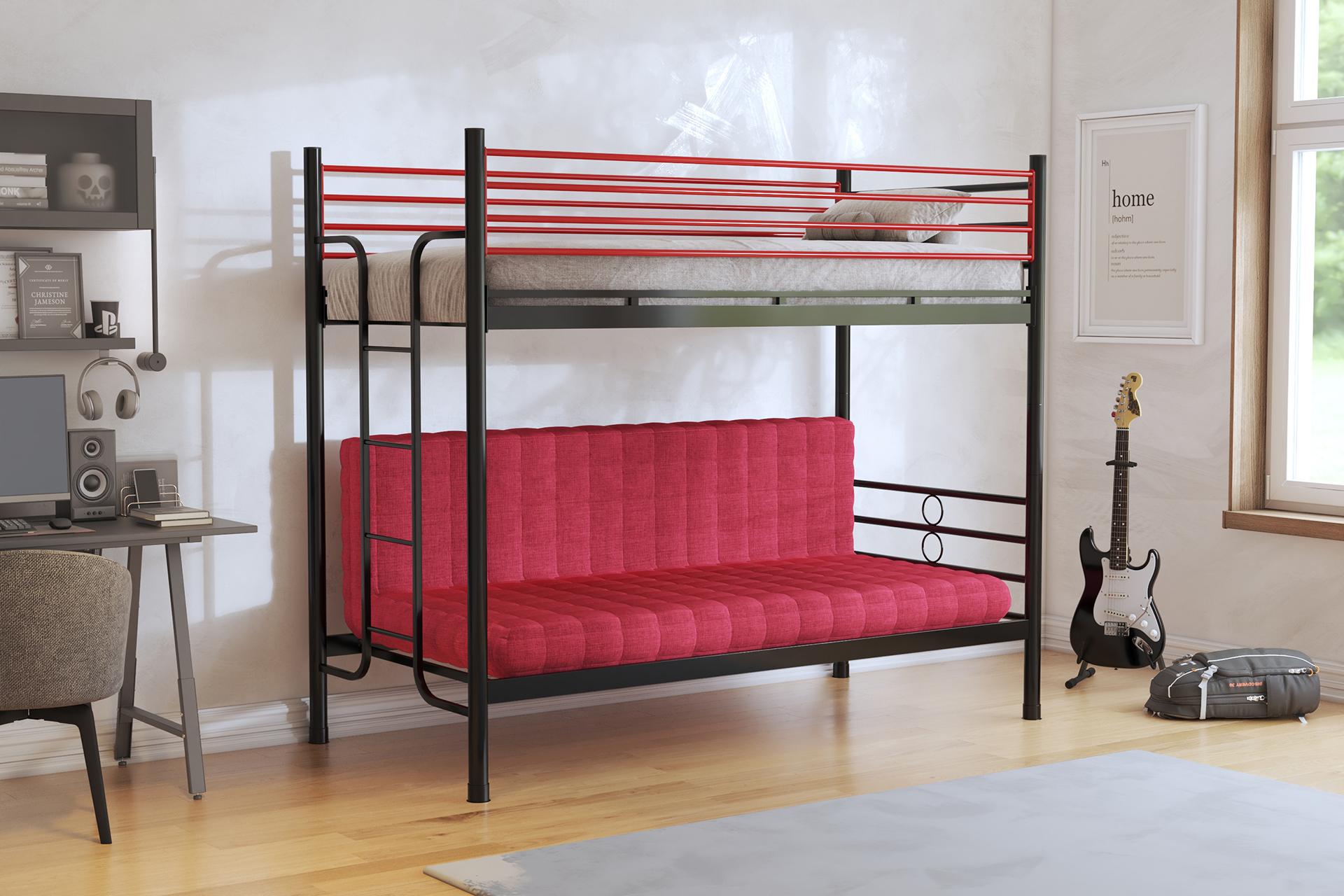 The Futonmax system optimizes tight spaces by combining a daytime seating lounge with a secure nighttime platform.
2. Revolutionary Convertible Architectures
Innovation in the commercial furniture sector has evolved past static, unmoving frames. The most efficient way to save space is to utilize modularity. A smart bunk adapts seamlessly to the shifting routines of its occupant. The Futonmax framework is a brilliant example of this evolution. During daytime study hours, the bottom tier operates as a premium, ergonomic sofa. When night falls, the high-density foam cushions fold completely flat, instantly transitioning into a wide, orthopedic bed.
This level of convertibility means the room does not need separate lounge chairs or extra mattresses. Furthermore, models like the Toronto introduce a twin-over-full configuration. By pairing a 140 cm wide bottom tier with a 90 cm top tier, this unique bunk comfortably accommodates up to three individuals in the same vertical footprint. A versatile bed provides exceptional utility in shared suites or family-oriented campus housing.
"A convertible sleeping frame does not just save physical floor space; it actively preserves the operational budget by eliminating the need to purchase secondary seating and lounging furniture for the residents."
3. Unyielding Metallurgy: The Core Skeleton
Creating a towering structure that handles the shifting, dynamic weight of young adults requires uncompromising metallurgy. We strictly avoid utilizing brittle iron components because cheap casting methods inevitably introduce microscopic flaws that fracture under stress. Instead, the ultimate core of any commercial frame relies exclusively on cold-rolled steel.
A dedicated producer operating a state-of-the-art factory understands that the longevity of the furniture depends entirely on the thickness of the primary pillars. The Santiye and Motif collections deploy massive 40x40-1.20 mm square profiles, creating an indestructible vertical spine. Conversely, hybrid models like the Damla and Rivals utilize monumental 51Ø circular columns. This incredibly heavy duty approach guarantees that the bed will never bow, snap, or collapse, ensuring decades of safe, uninterrupted service.
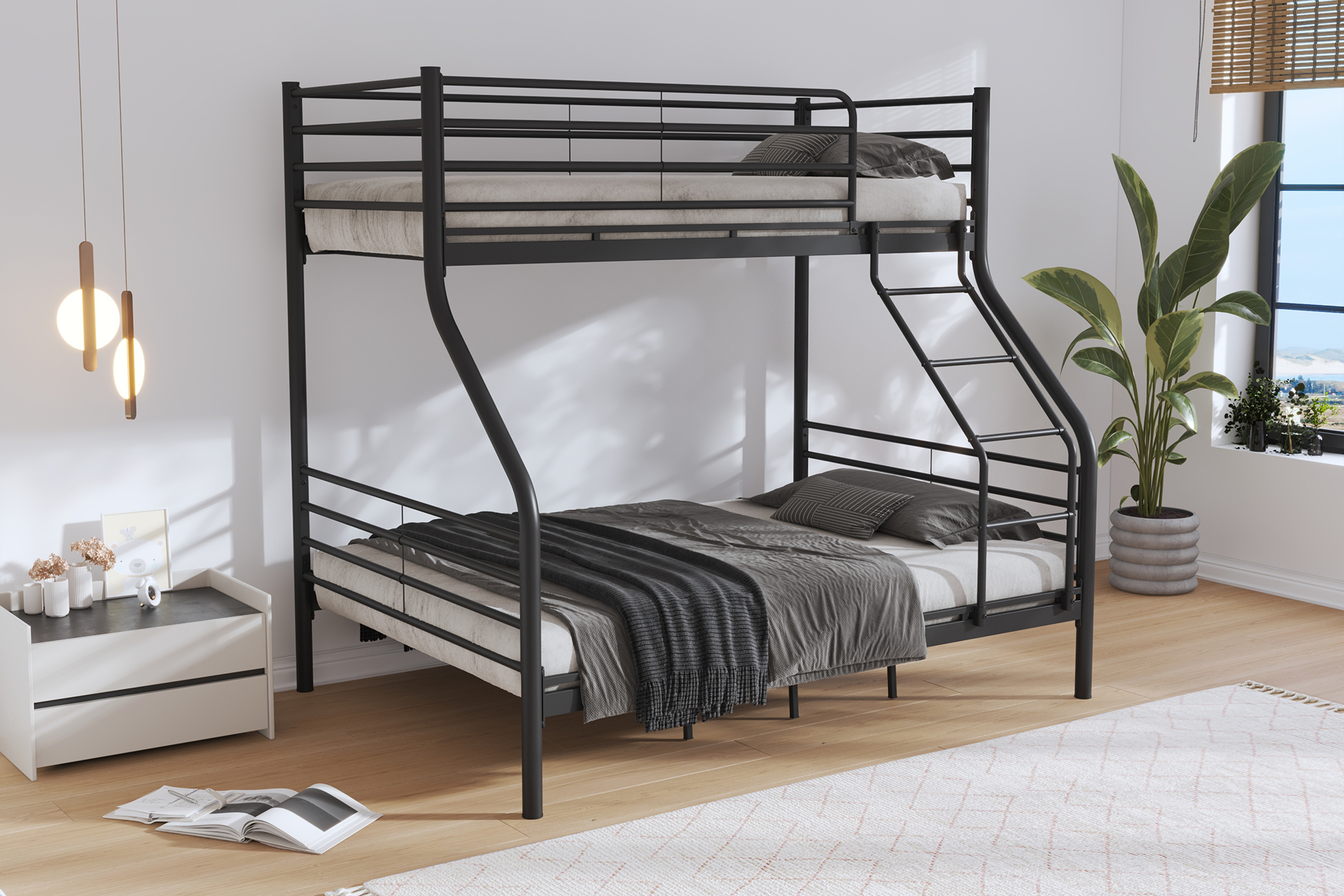 The Toronto model features a 140cm wide bottom bed beneath a standard 90cm top bunk, maximizing resident capacity.
4. Acoustic Eradication for Shared Environments
Cramming multiple residents into a compact space introduces severe auditory challenges. A bustling hostel suffers immensely when squeaking, noisy furniture continuously disrupts the sleep cycles of its guests. If one occupant turns over on a cheap metal bed, the resulting friction echoes throughout the entire room.
To resolve this, advanced engineering eliminates metal-on-metal contact entirely. Premium models incorporate noise reducer plastic caps that cap the ends of the 15x25 mm knock-down slats. This advanced polymer barrier isolates the mattress foundation from the primary side beams. An exhausted worker or a stressed student requires deep, undisturbed rest. A silent bunk guarantees that kinetic movement is absorbed flawlessly without generating a single decibel of noise.
5. Aesthetics, Privacy, and Human-Centric Design
Historically, high-density accommodations felt incredibly institutional and cold. Today, a modern campus aims to create a welcoming, inspiring environment. Even an emergency shelter or a transitional refugee facility benefits profoundly from furniture that offers psychological warmth and dignity.
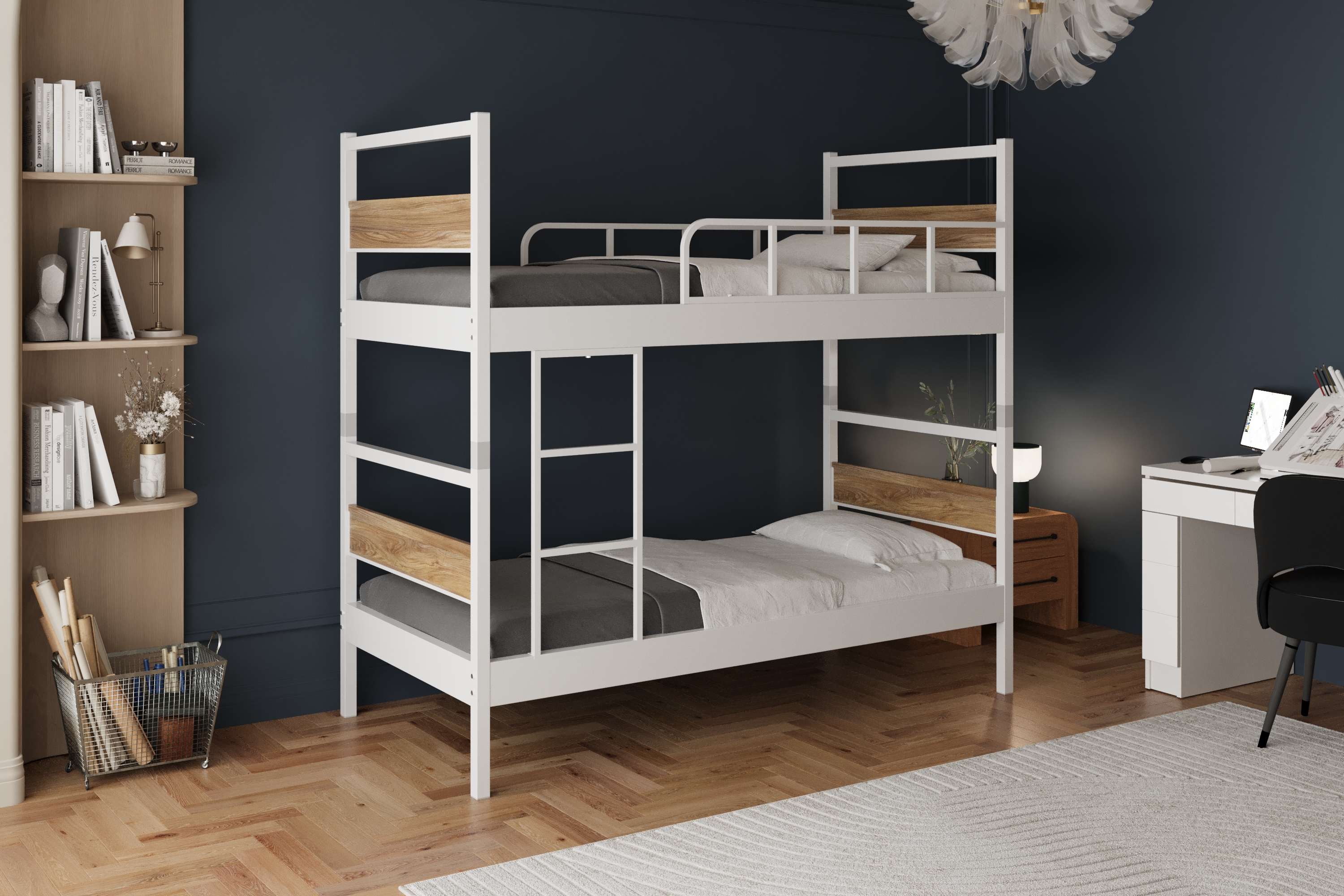 The Yurt platform utilizes solid 18mm wood panels to provide exceptional privacy in shared living quarters.
Hybrid architectures blend the indestructible nature of metal with the inviting texture of organic materials. The Yurt model utilizes full-length 18mm chipboard panels that enclose the headboards entirely. This provides the sleeper with a semi-private, cabin-like enclosure, effectively blocking out ambient light and granting personal boundaries within a crowded room. For ultra-premium suites, the Dora framework masks its steel columns behind luxurious, fabric-upholstered headboards. An elegant bed normalizes the space, proving that commercial-grade furniture can be genuinely beautiful.
6. Safety Certifications and Ergonomic Ascents
Vertical expansion introduces the inherent risk of falls. A high-security prison or a strict correctional center demands fixtures that meet rigorous safety mandates to prevent injuries or tampering. The N747 platform actively mitigates these institutional risks by proudly bearing the official TS EN 747-1 safety certification. This European standard ensures that the gaps between the upper safety barrier and adjacent architectural elements never exceed the critical 75 mm to 230 mm entrapment zone.
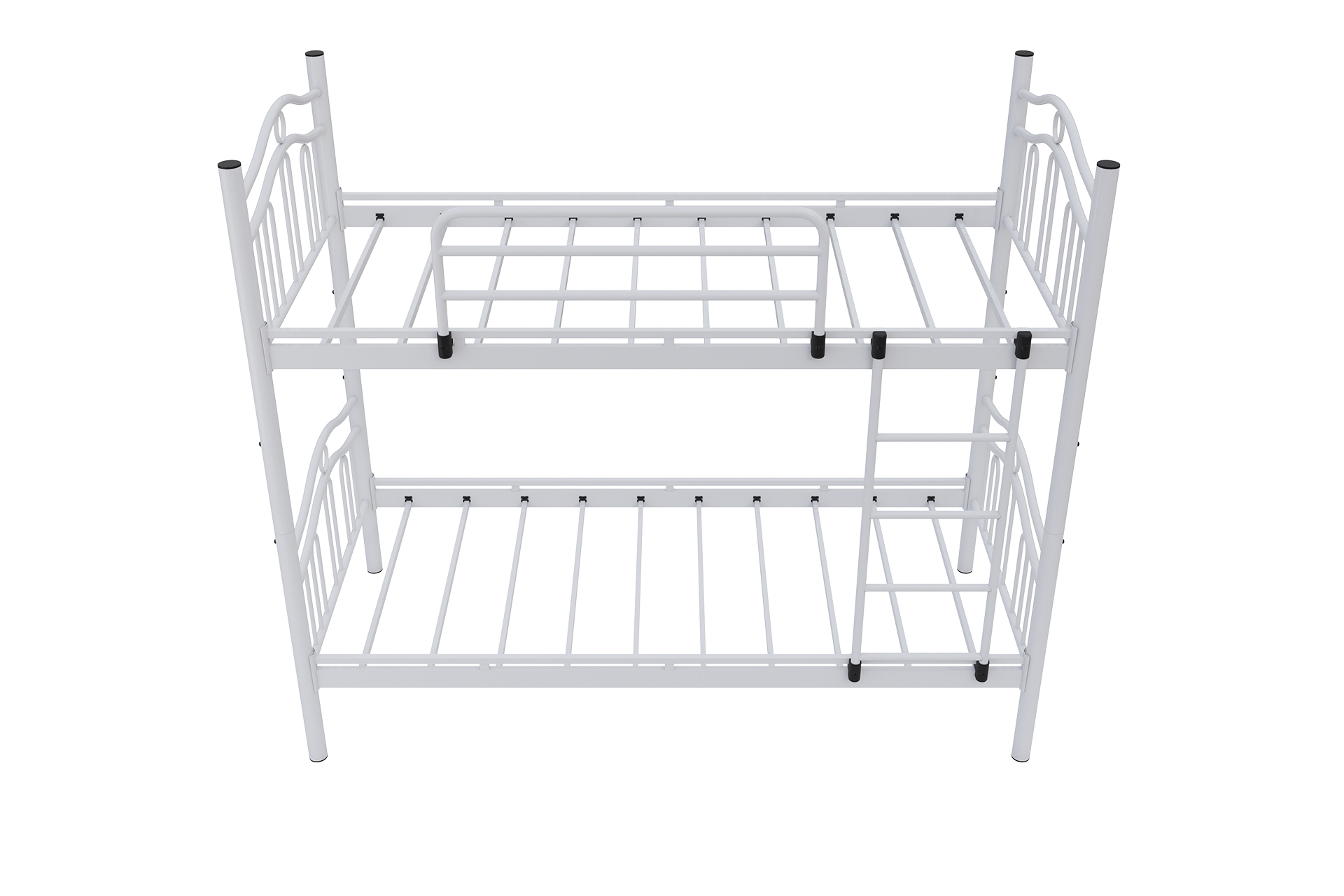 The angled ladder on the Boston model shifts the center of gravity forward, drastically reducing the risk of slipping.
Furthermore, climbing ergonomics play a massive role in daily safety. Standard vertical ladders force the user into awkward, unnatural angles. The Boston and Mix frameworks revolutionize this by introducing a highly functional angled ladder. This slight outward slant shifts the climber's center of gravity forward, vastly reducing the risk of slipping backward during a late-night ascent. A secure bunk protects the resident from the ground up.
7. Hyper-Volume Global Logistics
Successfully outfitting a massive residential complex requires flawless global logistics. Shipping fully assembled furniture across oceans destroys capital budgets due to the high volume of empty air inside the cartons. An experienced wholesale distributor solves this by utilizing extreme flat-pack engineering.
By engaging an international supplier, universities benefit from designs like the Delta platform. The elegantly curved wire patterns are fully demountable, compressing the primary carton depth down to an astonishing 14 cm. This hyper-volume optimization allows a single 40'HC shipping container to accommodate roughly 450 pieces. A intelligently packaged bed reduces maritime freight costs exponentially, ensuring the project remains strictly within financial boundaries while delivering unparalleled commercial quality.
Frequently Asked Procurement Questions
Does an active army camp or military base use similar commercial frames?
Yes, the defense forces frequently utilize these exact 51Ø and 40x40mm profiles. The unyielding nature of a tactical architecture perfectly translates into the extreme durability required for student populations.
How do you prevent noise in a crowded dormitory or hostel?
We completely eradicate metal-on-metal friction. A premium housing unit relies on our advanced noise reducer plastic caps, which isolate the horizontal slats from the side rails, ensuring a totally silent rest environment.
Are these modular frames adaptable for a refugee center or temporary shelter?
Absolutely. The screw-secured insert nipples allow the towering frames to separate into individual floor-level platforms instantly. This adaptability is highly prized in a dynamic environment where spatial needs shift daily.
Is the framework safe enough for a high-security prison or correctional institution?
Yes, the thick-gauge alloys and threaded mechanical joints provide immense tamper-proof resilience. A secure building requires this exact type of reinforced, monolithic stability to maintain safety protocols.
Why choose cold-rolled steel over cast iron from your factory as the direct producer?
Cast metal contains microscopic flaws that make it brittle under dynamic stress. As a dedicated manufacturer operating a state-of-the-art plant, we use pure alloys to ensure the profiles possess the necessary elasticity to absorb impacts without snapping.
Can a local worker assemble these easily via a wholesale supplier delivering heavy duty frames?
Yes! Our global distribution network provides highly intuitive, pre-engineered parts. Furthermore, specialized models feature a tool-free interlocking system, allowing a laborer to erect the industrial-strength frame in just 30 seconds, saving massive bulk installation costs.