
Why Dormitories Are Switching to Metal Slat Bunk Beds
When upgrading campus housing, facility managers are rapidly discovering exactly why dormitories are switching to metal slat bunk beds for their primary sleeping infrastructure. By collaborating directly with a reliable bunk bed manufacturer, institutions can eliminate the endless maintenance cycles associated with outdated wooden bases or sagging spring meshes. The mattress foundation is arguably the most critical component of any commercial sleeping platform. It dictates the ergonomic comfort of the resident, the lifespan of the expensive foam mattress placed upon it, and the overall auditory hygiene of the shared room.
1. The End of Organic Degradation
For decades, commercial facilities relied on wooden planks to support their mattresses. However, organic materials possess inherent flaws when deployed in high-density environments. A modern hostel or an academic dormitory faces relentless daily wear. Wood absorbs ambient moisture from the air, causing it to warp, expand, and eventually crack under localized pressure. Once a wooden slat fractures, the entire sleep surface becomes compromised, forcing procurement teams to order constant replacements.
In stark contrast, industrial-grade alloy foundations offer unyielding permanence. Utilizing 10 pieces of robust 15x25-0.70 mm tubular profiles, an advanced commercial bed evenly distributes the occupant's weight. This rigid geometric array refuses to bow, creating an immortal spine for the structure. Facility directors no longer have to worry about broken planks rendering a tiered bed entirely unusable.
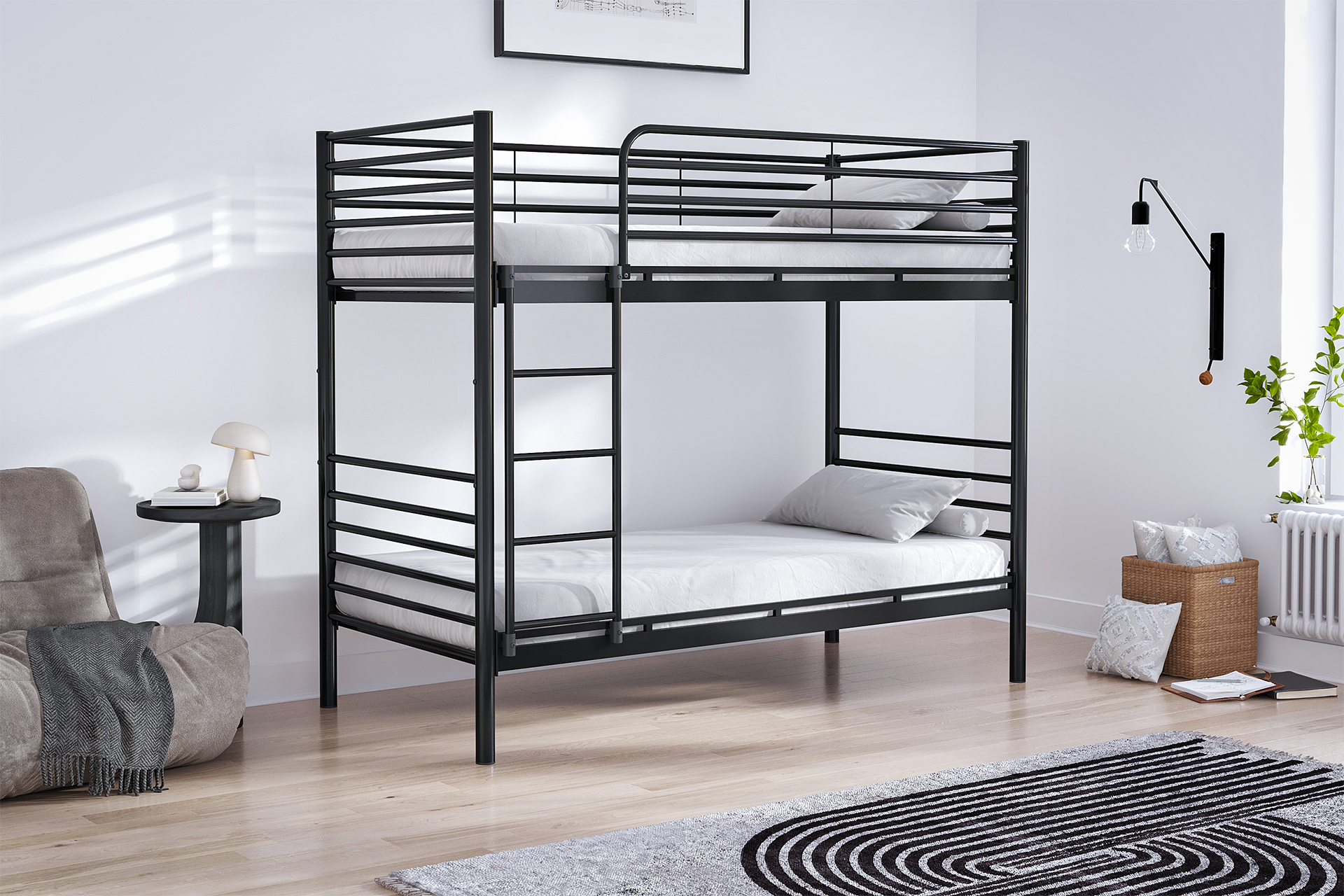 The N747 platform combines 9 heavy-duty slats with a dense wire mesh grid, providing the ultimate anti-sagging foundation.
2. Orthopedic Superiority and Spinal Support
A cheap spring mesh foundation is a physical disaster for the human spine. Springs stretch and sag over time, creating a hammock effect that forces the sleeper's back into an unnatural curvature. An exhausted worker requires deep orthopedic rest to recover properly after a grueling physical shift. Without a flat, rigid foundation, residents wake up experiencing chronic lumbar pain.
Tubular alloy slats solve this ergonomic crisis completely. Because the 15x25 mm or 20x30 mm profiles remain perfectly horizontal, the foam mattress above them maintains its intended shape. The mattress does not sink through the gaps, which effectively doubles the lifespan of the foam itself. A supportive bed guarantees that the sleeper enjoys flawless spinal alignment, promoting healthier, more restorative sleep cycles.
"The mattress foundation is the unsung hero of institutional furniture. A rigid, mathematically spaced grid protects the expensive foam mattress above it, saving the facility thousands of dollars in premature replacement costs."
3. Eradicating Biological Hazards and Bed Bugs
In any shared accommodation, hygiene is a non-negotiable operational metric. Wooden slats are highly porous, harboring bacteria and absorbing bodily fluids over years of use. More alarmingly, the microscopic crevices found in organic wood grains serve as the perfect nesting ground for Cimex lectularius—commonly known as bed bugs. An infestation can shut down an entire wing of a building, costing immense capital in extermination fees.
A state prison or a secure correctional center must eliminate biological hazards entirely to maintain safe living conditions. A displaced refugee transition hub or an emergency shelter needs sanitary platforms that can be rapidly cleaned between different occupants. The non-porous nature of a powder-coated alloy slat makes it utterly impossible for bed bugs to nest. The smooth, seamless surface of a metallic bunk allows cleaning staff to sanitize the entire unit in minutes using standard industrial disinfectants.
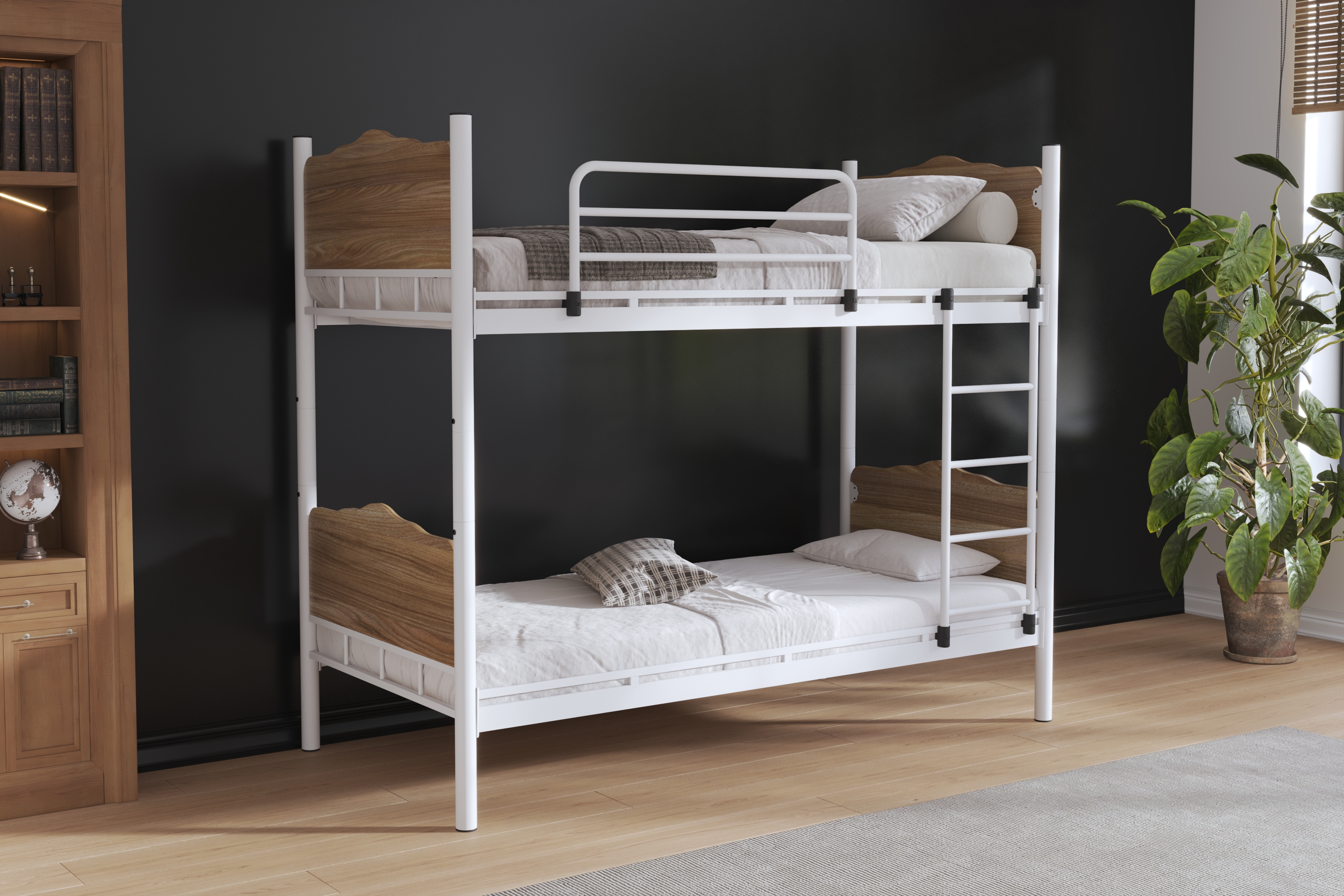 Even hybrid models like the Daisy hide an indestructible, hygienic alloy slat system behind their elegant wooden side rails.
4. The Acoustic Revolution: Noise Reducer Caps
One of the most persistent myths in the furniture industry is that metallic frames are inherently noisy. This is true for cheap retail models where the horizontal support bars are loosely tied or poorly welded directly to the main chassis, causing a terrifying metallic squeak every time the user breathes. However, advanced engineering has resolved this friction completely.
A tactical military compound or an active army base demands heavy duty infrastructure that operates silently. To achieve absolute acoustic eradication, modern designs utilize noise reducer plastic caps. These high-density polymer barriers are fitted over the ends of every single knock-down slat. When the slat is inserted into the 20x60 mm side rail, the plastic completely isolates the two metallic surfaces. Therefore, no matter how aggressively the occupant moves on the elevated bunk, zero friction occurs, and zero noise is generated. A completely silent bed is a massive psychological upgrade for densely populated rooms.
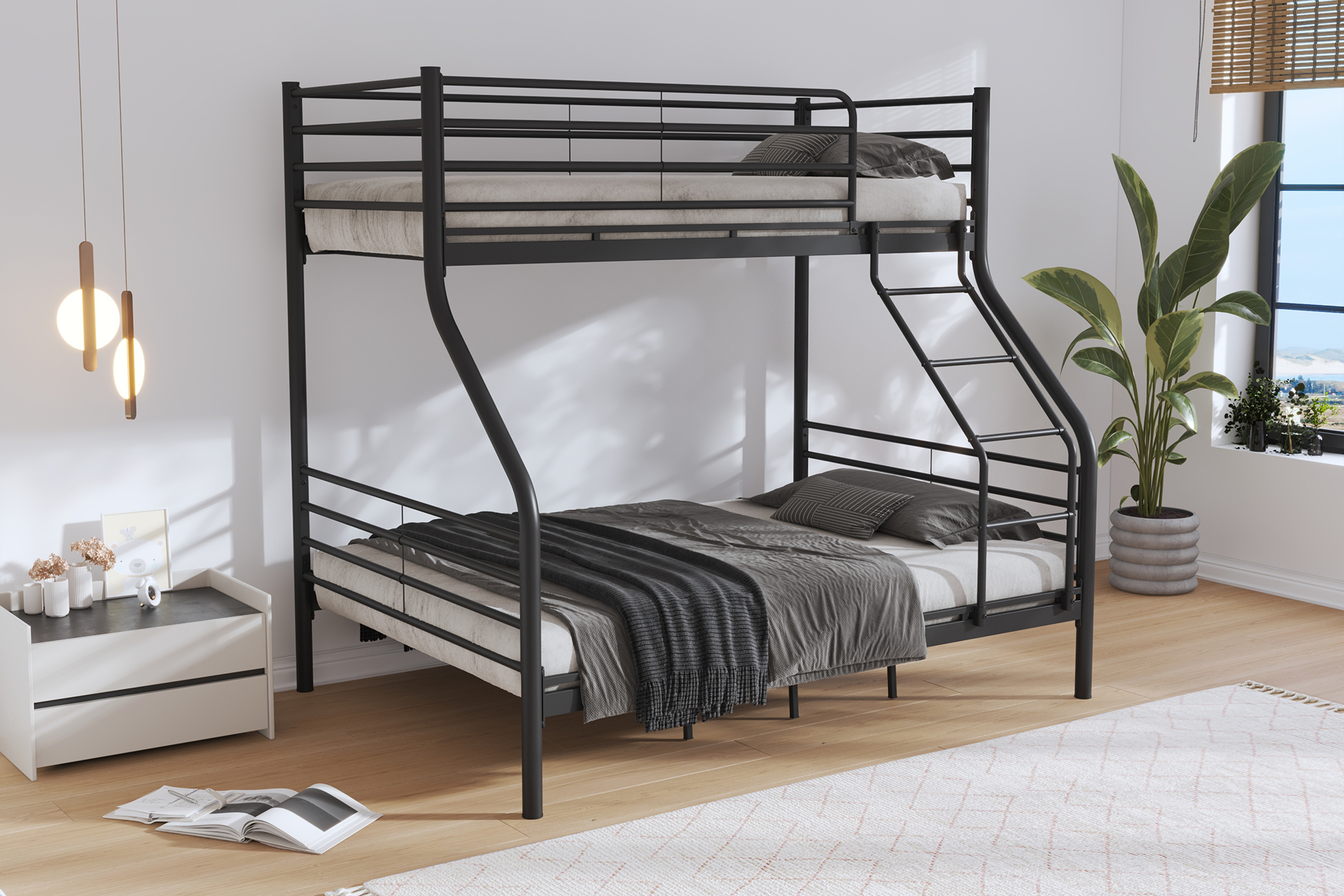 The Toronto's expanded 140cm bottom tier utilizes ultra-thick 20x30mm slats to eliminate mattress sagging under dual adult weight.
5. Unyielding Metallurgy and Load Distribution
To carry immense dynamic loads securely, the structural skeleton must be flawless. As a direct producer operating an automated factory, we reject brittle iron and utilize pure cold-rolled steel. Cast metals contain microscopic internal fissures that snap unpredictably under sudden impacts. Cold-rolled profiles provide the necessary tensile elasticity to absorb kinetic energy without permanently deforming.
This strength is critical when designing asymmetrical layouts. For example, the Toronto architecture features a massive 140 cm wide bottom tier. A standard 15x25 mm profile might bow under this extended span. To counter this, differential engineering is applied, reinforcing the wider bottom tier with exceptionally thick 20x30-1 mm profiles. A highly engineered bunk guarantees that even if multiple adults sit on the edge simultaneously, the framework will never yield.
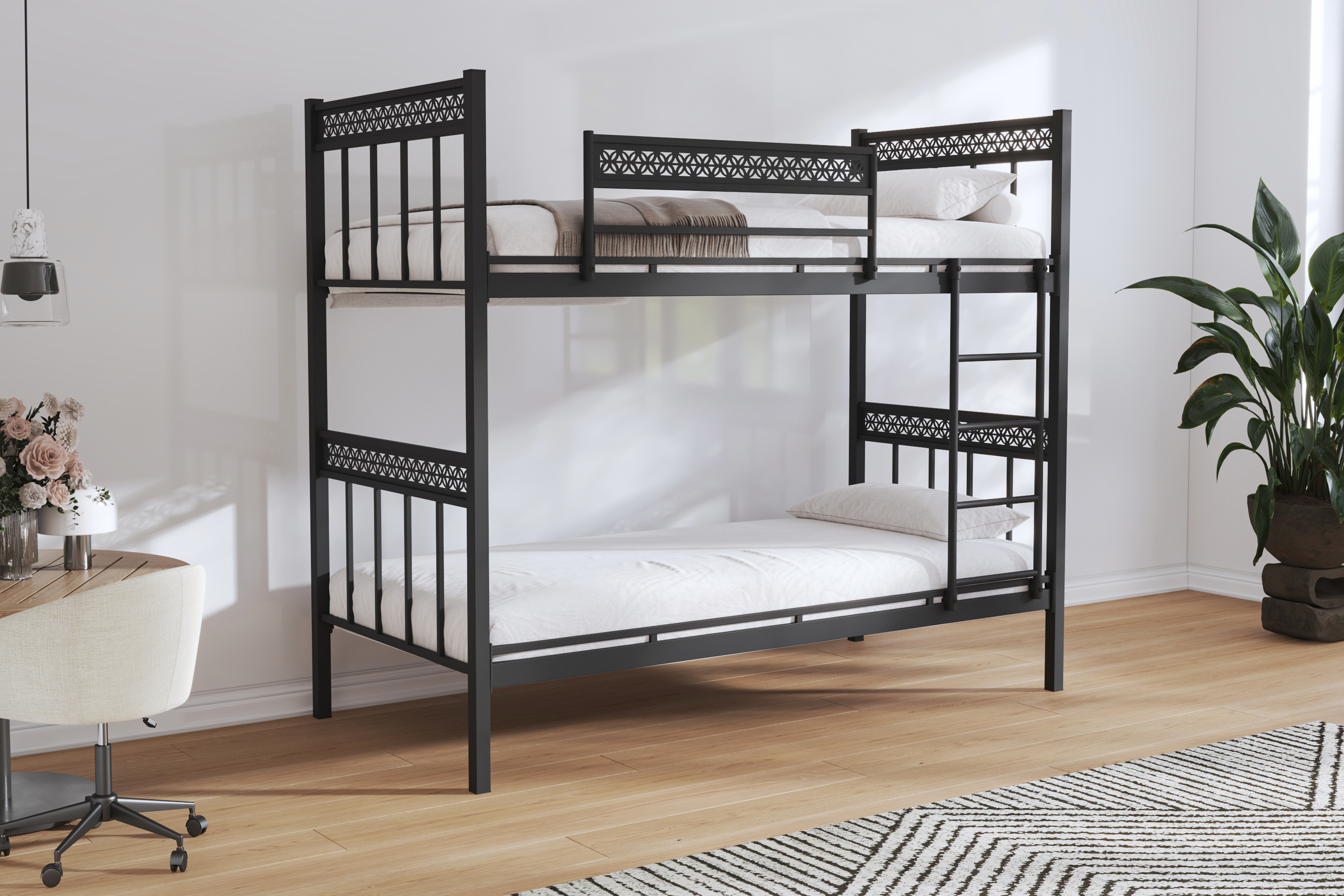 The geometric square profiles of the Motif model provide supreme resistance against lateral torsion, anchoring the entire slat system perfectly.
6. Seamless Global Supply Chain Integration
Upgrading thousands of sleeping platforms simultaneously is a massive logistical undertaking. A global supplier manages wholesale logistics efficiently by utilizing extreme flat-pack techniques. Because these advanced slats are engineered as "knock-down" components rather than fully welded grids, they can be stacked incredibly tight inside the shipping carton.
This modularity drastically compresses the overall packaging depth. A disassembled bed can fit seamlessly into a 14 cm deep box, allowing hundreds of units to be loaded into a single shipping container. This brilliant packaging strategy slashes maritime freight costs exponentially, allowing institutional buyers to allocate their capital towards acquiring premium, heavy-gauge platforms rather than paying for empty cargo space.
Frequently Asked Procurement Questions
Does an active army camp or military base use these frames?
Yes. The defense forces frequently utilize these exact alloy profiles. The unyielding nature of this tactical architecture perfectly translates into the extreme durability required for massive troop deployments.
How does a hostel or student dormitory benefit from metal slats?
Unlike wood, these industrial grids never snap, warp, or harbor bed bugs. They provide a permanently flat, orthopedic surface that extends the life of expensive foam mattresses significantly, pleasing both guests and accountants.
Are these suitable for a refugee center or crisis shelter?
Absolutely. The non-porous surfaces can be sanitized instantly, preventing biological hazards from spreading. Furthermore, the modular layout allows administrators to assemble and disassemble the tiered platforms rapidly based on fluctuating populations.
Do you operate as the direct producer and factory?
Yes, we bypass middlemen entirely. All platforms are forged in our advanced automated plant. We control the metallurgical quality from the raw material stage to the final electrostatic powder coating.
Can an international supplier handle a large wholesale order?
Yes. We specialize in global bulk logistics. Because our knock-down slats stack flawlessly, we compress our carton dimensions to maximize shipping container volume, lowering your landed costs exponentially.
Is the frame safe for a prison or correctional facility?
Yes. The heavy-gauge alloys and threaded mechanical joints provide immense tamper-proof resilience. A secure detention building requires this exact type of reinforced, monolithic stability to maintain safety protocols.
Is the platform comfortable for an industrial worker needing heavy duty support?
Absolutely. The dense orthopedic grid prevents the mattress from sinking like a hammock. A robust structure guarantees flawless spinal alignment for laborers needing deep physical recovery after grueling shifts.
Why choose high-tensile steel over cheap iron?
Cast casting contains microscopic flaws that make it brittle under dynamic stress. We use pure cold-rolled alloys to ensure the profiles possess the necessary elasticity to absorb sudden impacts without snapping.