
How to Choose Heavy-Duty Bunk Beds for University Dormitories
When designing exceptional campus housing, sourcing the perfect heavy-duty bunk beds from a reliable bunk bed manufacturer is the foundation of long-term operational success. Managing thousands of scholars requires an overarching architectural strategy that goes far beyond standard residential furniture. A highly active army installation or a secure military compound demands unyielding infrastructure, and modern campus housing must adopt this exact same heavy duty philosophy. Engaging in a strategic wholesale procurement process allows universities to acquire premium sleeping platforms while aggressively protecting their capital budgets against continuous replacement costs.
1. The Core Architecture: Advanced Metallurgy and Profiles
The structural secret behind an indestructible multi-tier frame is the meticulous selection of its core metallurgy. We must completely avoid using brittle iron, as inferior casting techniques create microscopic internal fissures that snap unpredictably under dynamic pressure. Instead, a towering commercial frame must be forged exclusively from premium cold-rolled steel. A dedicated producer operating an automated factory understands that the thickness and geometric shape of the metallic profiles determine the total lifecycle of the furniture.
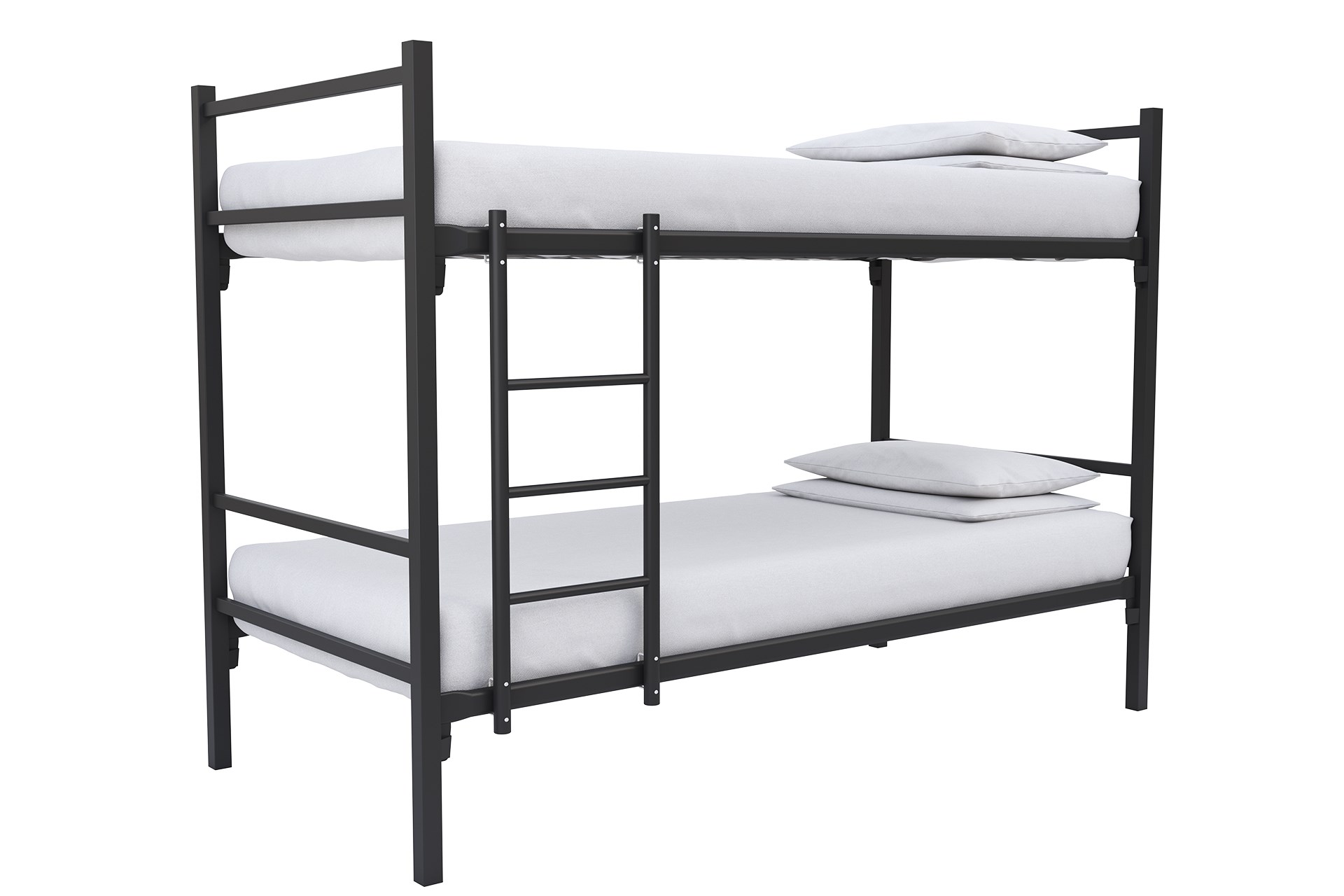
The Santiye model demonstrates extreme 40x40mm column geometry designed for intense commercial loads.
To absorb intense kinetic energy, administrators must look closely at the primary vertical columns. The Santiye and Motif commercial collections, for instance, deploy massive 40x40-1.20 mm square profiles. The rigid 90-degree corners of a square tube provide unparalleled resistance against lateral torsion. Conversely, premium hybrid lines like Damla, Rivals, Woodex, and Boston utilize monumental 51Ø circular pillars with up to 1.20 mm wall thickness. A circular column eliminates dangerous sharp edges, creating a softer visual profile while retaining absolute structural dominance.
However, vertical strength means nothing if the horizontal load-bearers fail. The main side beams act as bridges carrying the occupant's weight. A superior frame deploys deep rectangular profiles, such as 20x60-1 mm or 25x50-1.50 mm beams, heavily fortified by secondary inner supports (like 20x20-0.70 mm tubing). This dual-rail engineering guarantees that a solid bed will never bow, warp, or sag, even when multiple adults sit on the edge simultaneously.
"Retail furniture is engineered for static, gentle resting. In contrast, an institutional sleeping structure acts as a study space, a social lounge, and a step-ladder. A commercial bunk must possess extreme geometric depth to manage these complex, multi-directional stress vectors flawlessly."
2. The Eradication of Noise: Acoustic Slat Engineering
A bustling dormitory or a high-turnover hostel suffers immensely when ambient noise disrupts the natural sleep cycles of its residents. A tired worker requires deep, uninterrupted rest to recover properly after a grueling academic or physical shift. The most frequent complaint in shared commercial housing is the terrifying metal-on-metal squeak that occurs whenever an occupant turns over. This auditory pollution is caused by friction between the mattress foundation and the primary chassis.
To resolve this universally, acoustic engineering has revolutionized the modern platform. Cheap mesh systems sag and squeal, but advanced frames utilize distinct orthopedic solutions. The Toronto model, engineered for asymmetrical loads, utilizes heavy 20x30-1 mm thick metal slats to reinforce its expansive bottom tier. For ultimate anti-sagging performance, the N747, Rio, and Santiye platforms integrate a dense 6x7.5-2.8 mm wire mesh grid welded directly across the horizontal supports, doubling the lifespan of expensive foam mattresses.
The ultimate acoustic triumph, however, is the integration of noise reducer plastic caps. Seen in the Armoni, Woodex, and Daisy lines, these specialized polymer barriers cap the ends of the 15x25 mm knock-down slats. This brilliant plastic isolation physically prevents the metal slats from rubbing against the side beams. A completely silent bed elevates the commercial lodging experience to a boutique hospitality standard.
3. Maximizing Spatial ROI: Convertibility and Modularity
A strict state prison or a secure correctional facility requires tamper-proof, permanently fixed joints to maintain administrative order. However, an educational institution thrives on spatial adaptability. Demographic shifts occur rapidly; a room designed for three students this semester might need to accommodate two distinct private suites next year.
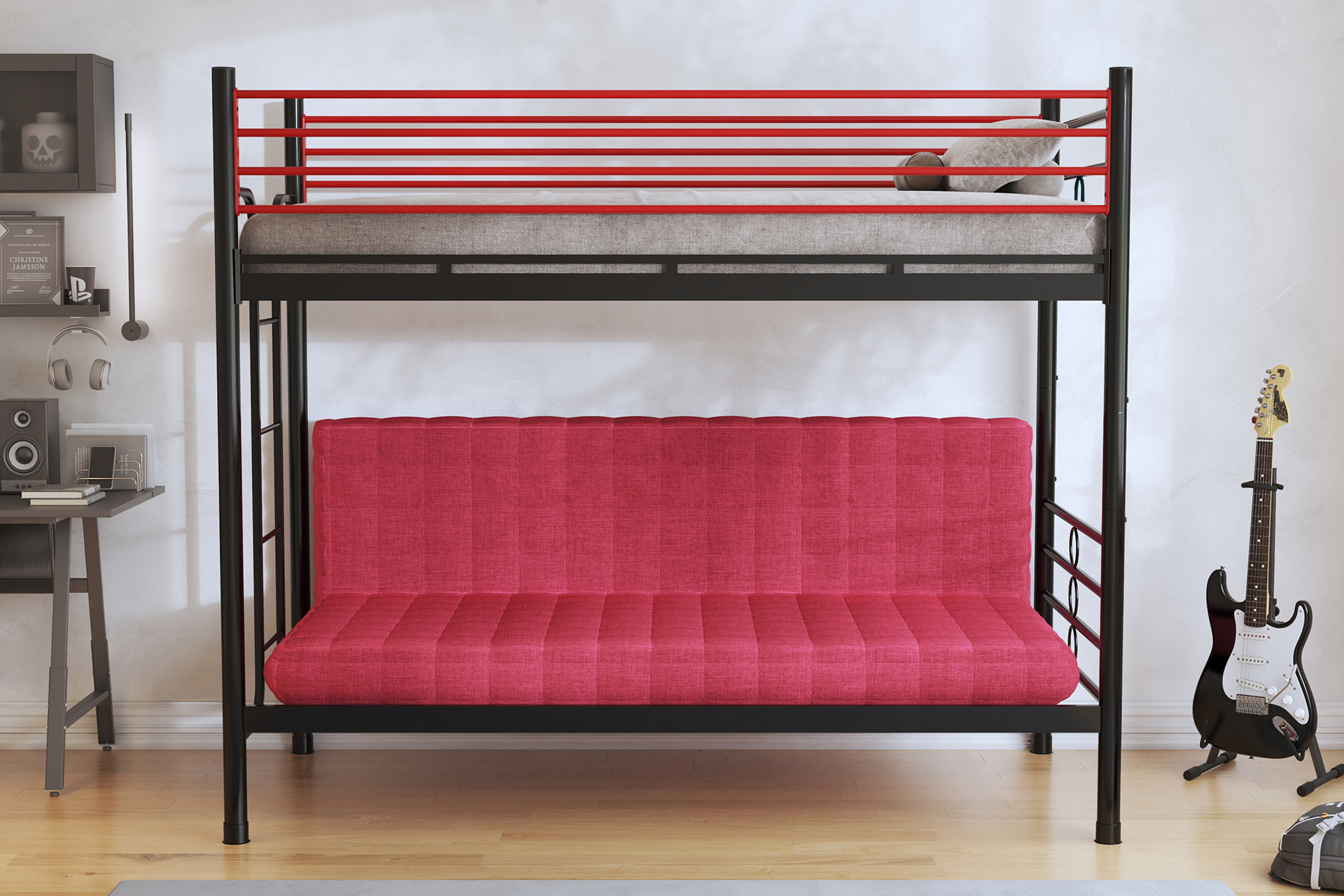
The Futonmax system seamlessly converts from a daytime lounge to an orthopedic nighttime platform.
Investing in a convertible frame is the ultimate safeguard against real estate unpredictability. The Damla, Armoni, and Rivals structures feature highly specialized, screw-secured metal profile insert nipples. Administrators can unbolt the towering frame in minutes, separating it into two identical, floor-level singles. Unlike cheap, gravity-stacked pins that wobble terrifyingly over time, these threaded connectors ensure the assembled bunk behaves as a monolithic, unshakable entity.
When maximizing a limited floor plan is the primary goal, the Toronto model offers a groundbreaking Twin-Over-Full configuration. By pairing a massive 140 cm wide bottom tier with a standard 90 cm top tier, facility directors effectively triple the room's occupancy while providing a luxurious sleep area. Alternatively, the Futonmax framework integrates an ingenious convertible sofa mechanism. During the day, the bottom tier operates as a premium seating lounge; at night, the high-density sponge cushions fold completely flat, instantly transforming into a spacious orthopedic sleeping platform. A highly adaptable bed eliminates the need to purchase supplementary furniture.
| Architectural Strategy | Ideal Campus Application | Primary Engineering Advantage |
|---|---|---|
| Separable (Convertible) Systems | Flexible university housing and private RA suites | Screw-secured insert nipples allow instant transformation into independent floor singles. |
| Twin-Over-Full (Asymmetrical) | Family housing units and expansive multi-student suites | 140 cm wide bottom tier fortified by extra-thick 20x30 mm metal slats to prevent bowing. |
| Futon Sofa Integration | Compact studio apartments and dedicated study rooms | Transitions from an ergonomic lounge to a flat platform using durable, tear-resistant upholstery. |
4. Aesthetic Normalization: Eliminating the Institutional Feel
Historically, mass accommodations featured cold, sterile, and highly brutalist environments. Today, a transitional refugee hub or an emergency shelter benefits profoundly from warm, human-centric interior design. An international supplier understands that the psychological comfort of the occupant is just as important as the physical durability of the furniture.
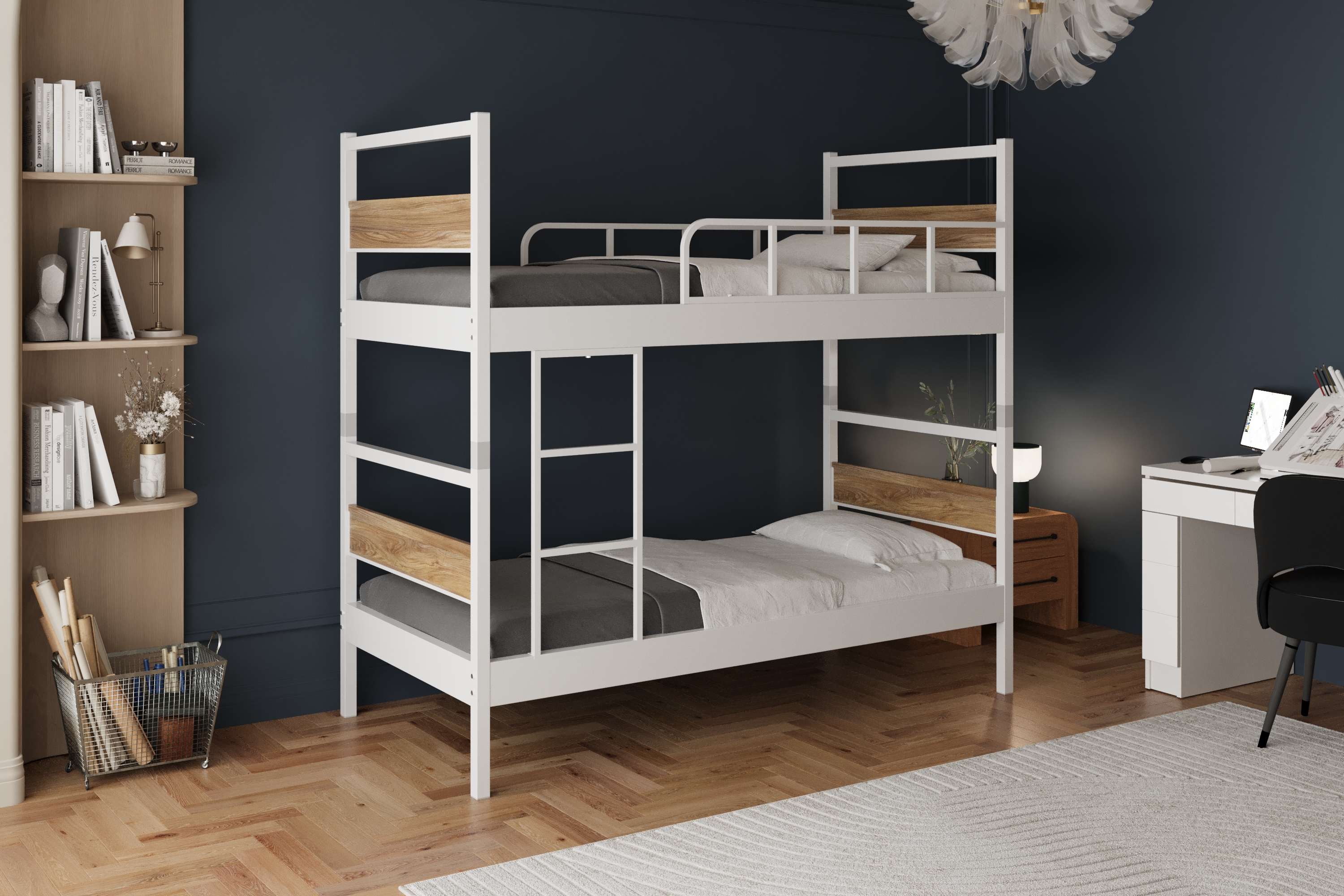
The Yurt platform utilizes 18mm full-wood panels to create a secluded, cabin-like aesthetic.
To achieve this, advanced frames embrace hybrid materials. The Yurt model introduces an incredible full-panel privacy concept, utilizing solid 18mm chipboard (Sunta) to entirely enclose the headboards, creating a secluded, cabin-like sanctuary for the user. The Woodex and Armoni platforms blend industrial resilience with elegant Walnut or Cordoba wood accents, softening the room's visual tone beautifully.
For facilities aiming for ultra-premium aesthetics, the Dora framework completely masks its indestructible 51Ø pillars behind lush, upholstered headboards. Combining 0.18mm chipboard with high-density foam and soft fabric, this plush bed provides a boutique hotel experience. A stunningly customized bunk allows administrators to match corporate branding perfectly via a vast spectrum of electrostatic powder-coated metal finishes and fabric choices.
5. Uncompromising Safety Metrics and European Certifications
Institutional liability is a massive concern for property developers. The N747 platform actively mitigates legal risks by proudly bearing the official TSE TS EN 747-1 safety certification. This rigorous European testing protocol guarantees that the towering frame withstands extreme kinetic impact and sustained loading without structural failure.
Furthermore, safety engineering focuses heavily on entrapment prevention. The distance between the upper security guard rail and any adjacent architectural structures is meticulously calculated to never fall within the dangerous 75 mm to 230 mm hazard zone. Climbing ergonomics also play a crucial role in injury prevention. While standard vertical ladders force climbers into awkward angles, the Boston and Mix frameworks feature an innovative angled ladder design. This slight outward slant shifts the user's center of gravity forward, vastly reducing the risk of slipping backward during late-night ascents. Thick 25Ø and 21Ø ladder profiles ensure a comfortable, slip-resistant grip for bare hands and feet.
6. Hyper-Volume Logistics: The Math Behind the Savings
Procuring hundreds of units is only half the battle; navigating global maritime freight is where true financial mastery shines. Shipping fully assembled, hollow furniture across oceans destroys project budgets. The brilliant flat-pack engineering found in these models ensures that organizations pay exclusively for the product, not the empty air surrounding it.
Consider the Delta platform. By engineering the elegant headboard wire patterns to be fully demountable from the main 51Ø pillars during packaging, the primary carton depth is aggressively compressed from a standard 22 cm down to a mere 14 cm. This hyper-volume optimization reduces the total cargo footprint to an astonishing 0.152 m³. As a direct result, a single 40'HC shipping container can seamlessly accommodate roughly 450 pieces.
Even the massive 79.2 kg Yurt frame is intellectually divided into two manageable cartons, allowing roughly 137 units to fit into a container. A brilliantly packaged bed prevents missing hardware, streamlines cross-border customs clearing, and vastly accelerates the final on-site installation process.
Frequently Asked Procurement Questions
Does an army camp or military base use similar commercial frames?
Yes, the defense forces frequently utilize these exact 51Ø and 40x40mm profiles. The unyielding nature of a tactical architecture perfectly translates into the extreme durability required for student populations.
How do you prevent noise in a crowded dormitory or hostel?
We completely eradicate metal-on-metal friction. A premium housing unit relies on our advanced noise reducer plastic caps, which isolate the horizontal slats from the side rails, ensuring a totally silent rest environment.
Are these modular frames adaptable for a refugee center or temporary shelter?
Absolutely. The screw-secured insert nipples allow the towering frames to separate into individual floor-level platforms instantly. This adaptability is highly prized in a dynamic environment where spatial needs shift daily.
Is the framework safe enough for a high-security prison or correctional institution?
Yes, the heavy-gauge alloys and threaded mechanical joints provide immense tamper-proof resilience. A secure building requires this exact type of reinforced, monolithic stability to maintain safety protocols.
Why choose cold-rolled steel over cast iron from your factory as the direct producer?
Cast metal contains microscopic flaws that make it brittle under dynamic stress. As a dedicated manufacturer operating a state-of-the-art plant, we use pure alloys to ensure the profiles possess the necessary elasticity to absorb impacts without snapping.
Can a local worker assemble these easily via a wholesale supplier delivering heavy duty frames?
Yes! Our global distribution network provides highly intuitive, pre-engineered parts. Furthermore, specialized models feature a tool-free interlocking system, allowing a laborer to erect the industrial-strength frame in just 30 seconds, saving massive bulk installation costs.