
Safety First: Guardrails and Ladders in Dormitory Bunk Beds
When outfitting multi-story accommodations, ignoring structural safety metrics is a catastrophic error that exposes institutions to severe legal liability. Partnering directly with a certified bunk bed manufacturer is the only way facility directors can guarantee the physical well-being of their occupants. In massive residential complexes, the true danger does not lie in the mattress, but rather in the architecture of the dormitory bunk beds themselves. From preventing late-night falls to eliminating hazardous entrapment zones, mastering the engineering behind guardrails and climbing ladders is the foundation of secure, high-density housing.
1. The Architecture of Fall Prevention
The primary purpose of a commercial guardrail is not merely visual; it is a critical kinetic barrier. When an occupant is asleep on an elevated platform, their spatial awareness is zero. A sudden shift in weight during the rapid eye movement (REM) cycle can easily propel an adult toward the edge. Retail barriers often fail because they are built too low or are attached with weak, gravity-fed hooks that pop out under lateral pressure.
In an advanced institutional sleeping structure, the upper guardrail is an integrated, unyielding component of the main chassis. We construct these barriers using high-tensile, cold-rolled steel profiles—typically 15x15 mm or 20x20 mm—welded seamlessly into the primary 40x40 mm or 51Ø columns. A secure bed must feature a guardrail that extends significantly above the top of the mattress surface, ensuring that even a thick, 15 cm orthopedic foam mattress does not compromise the barrier's effective stopping height.
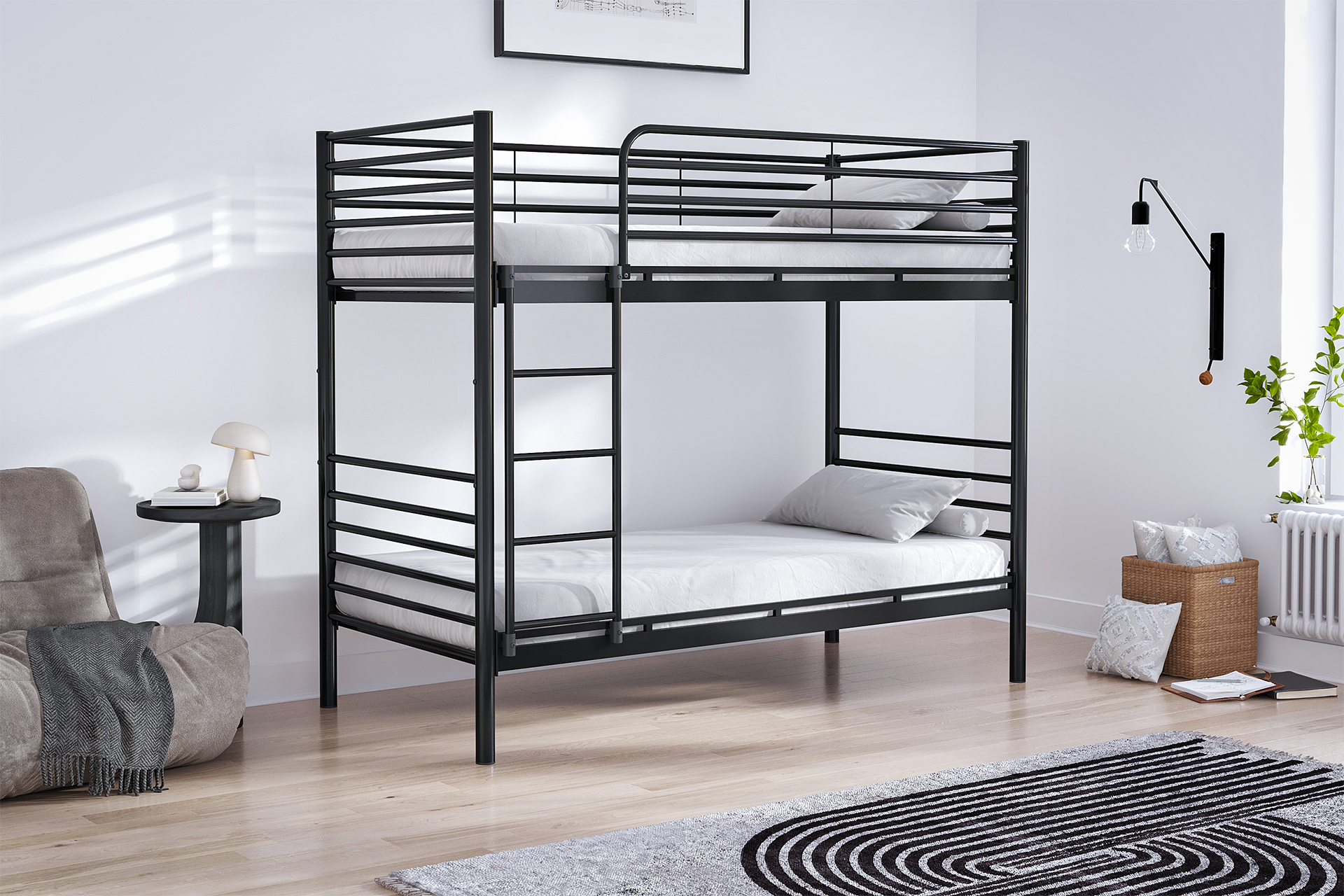 The N747 framework features TS EN 747 certified guardrails, specifically engineered to prevent accidental falls and mechanical entrapment.
2. Mitigating the Entrapment Hazard
While preventing a fall is crucial, the design of the guardrail itself must not introduce secondary dangers. In poorly engineered residential units, the gaps between the horizontal barrier bars, or the distance between the barrier and the mattress foundation, are often random. This lack of mathematical precision creates "entrapment zones" where a limb or, tragically, a head can become wedged.
To eliminate this, a responsible producer strictly adheres to global safety protocols. The most critical standard in the industry is the European TS EN 747-1 certification. This rigid mandate dictates that all gaps within the upper sleeping perimeter must be smaller than 75 mm or larger than 230 mm. By forcing the design outside this specific hazard window, a certified bed guarantees that no occupant can become trapped, securing both the resident's safety and the facility's legal standing.
"Safety is a mathematical absolute. A commercial framework is not judged by its aesthetic appeal, but by its millimeter-perfect adherence to EN747 and CPSC dimensional mandates."
3. Climbing Ergonomics: The Angled Ladder Revolution
Ascending to an elevated platform in the dark is inherently risky. Traditional vertical ladders compound this danger by forcing the climber into an awkward, entirely vertical posture. When climbing straight up, the user's center of gravity naturally pulls backward, away from the structure. If their grip slips, they fall directly backward onto the floor.
Innovative engineering solves this by altering the ascent trajectory. Models like the Boston and the Mix series feature a revolutionary angled ladder design. This slight outward slant physically shifts the user's center of gravity forward, pressing their body weight securely against the rungs. A safe bed ensures that if a foot slips, the climber falls forward onto the ladder itself, rather than backward. Furthermore, utilizing thick 21Ø or 25Ø tubular profiles for the rungs provides a comfortable, pain-free grip for bare feet and hands.
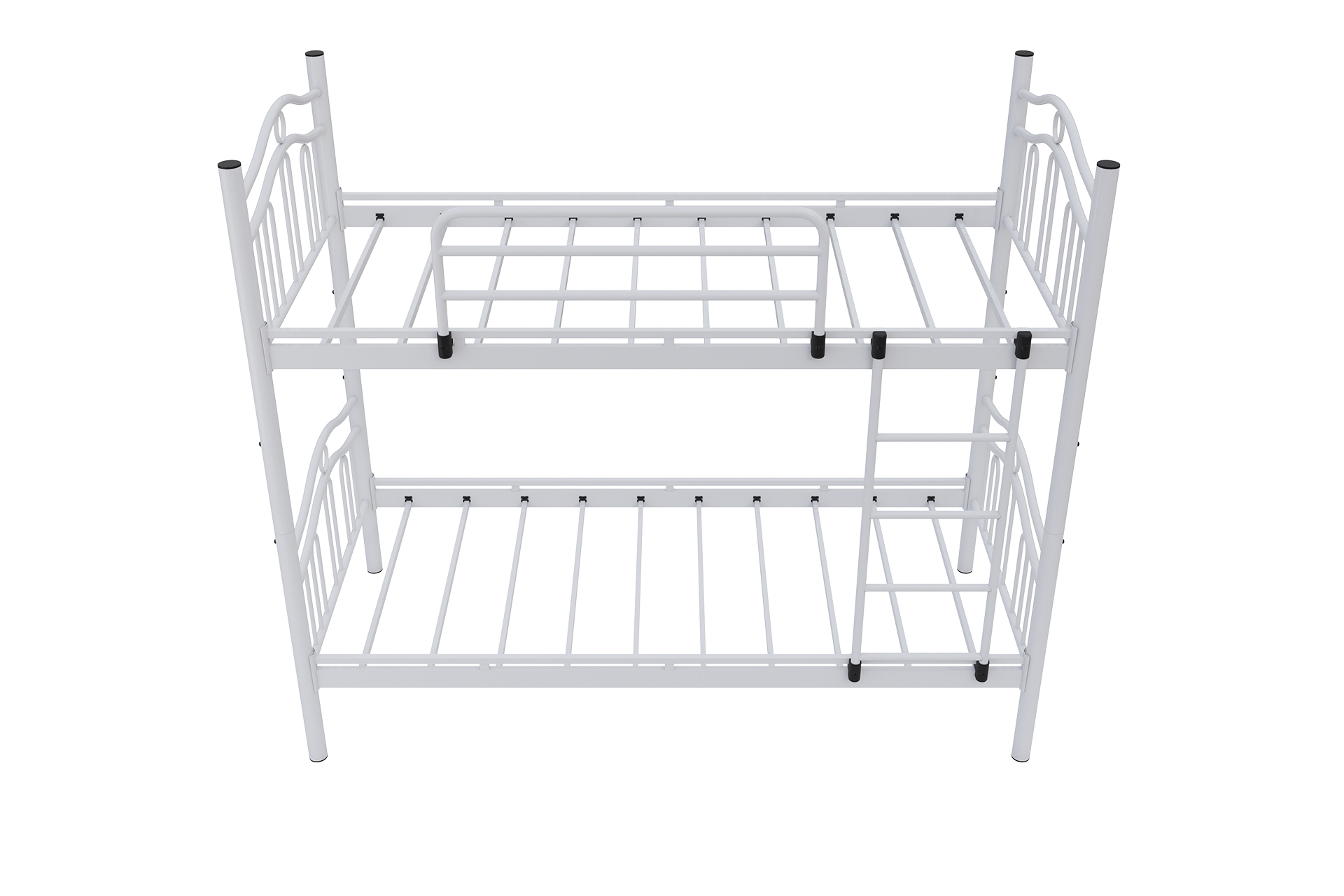 The ergonomic angled ladder on the Boston model shifts the center of gravity forward, drastically reducing the risk of slipping.
4. Monolithic Stability and Torsional Resistance
A brilliantly designed ladder is useless if the primary skeleton wobbles. The act of climbing generates immense lateral torsion—a twisting force that strains every joint in the furniture. If the structure sways, the climber loses their balance.
To combat torsion, an automated factory relies on extreme metallurgical thickness and geometric lock-ins. The Santiye and Motif collections deploy monumental 40x40 mm square profiles with wall thicknesses scaling up to 1.20 mm. The rigid 90-degree corners of these pillars prevent the side rails from twisting. Additionally, using threaded, screw-secured insert nipples rather than cheap gravity pins ensures the entire heavy-duty structure behaves as a single, unyielding monolith, absorbing kinetic shocks effortlessly.
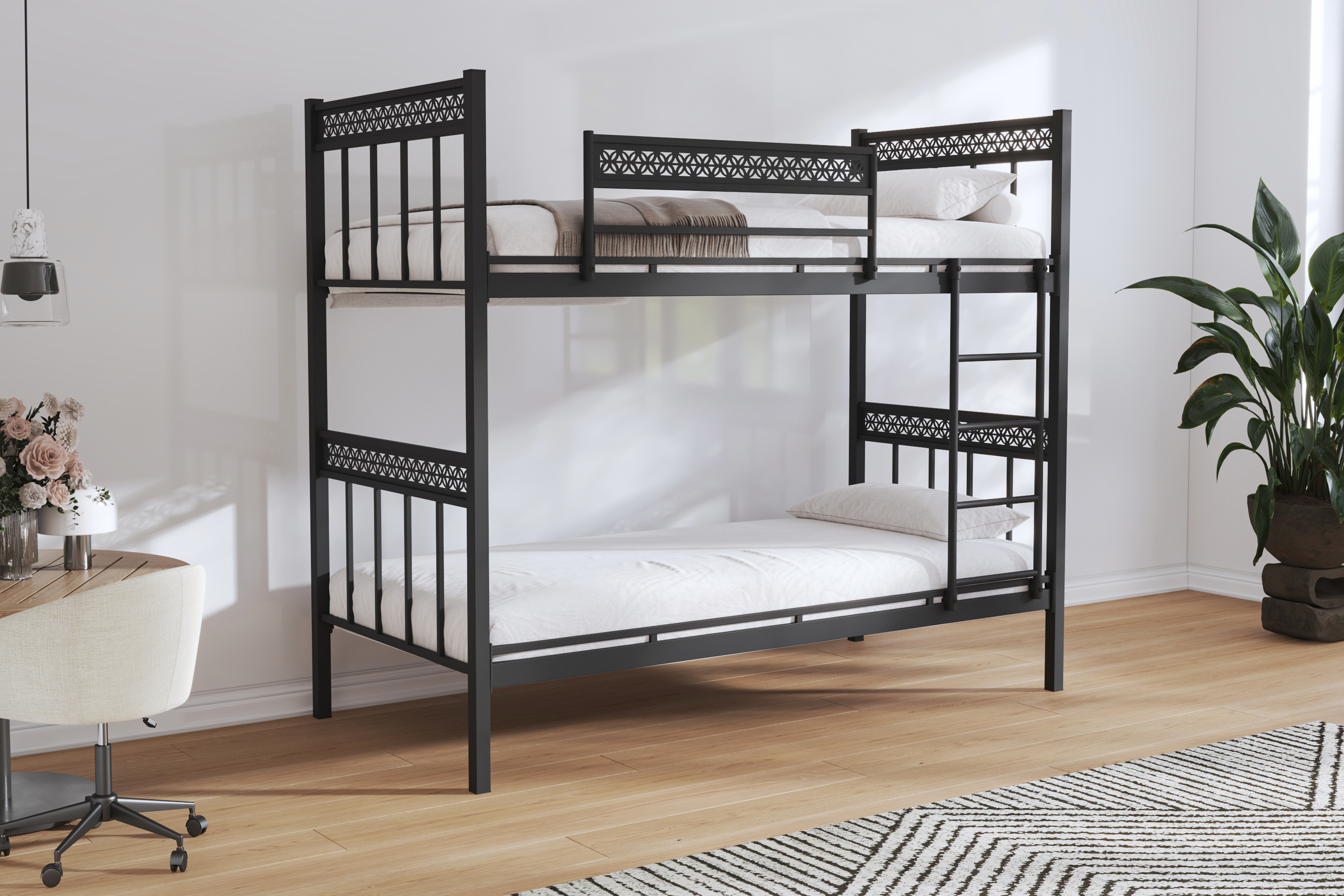 The geometric square profiles of the Motif framework provide supreme resistance against lateral torsion, ensuring the ladder remains completely motionless during climbing.
5. The Importance of Immovable Joints
In certain high-risk environments, such as a secure correctional facility, safety takes on an entirely different meaning. Here, the concern is not just accidental falls, but intentional tampering. Inmates often attempt to dismantle furniture to create weapons or hide contraband in hollow tubes.
To neutralize this threat, specialized commercial models use tamper-proof M6 and M8 threaded mechanical fasteners. Once assembled, these locking mechanisms require specific industrial tools to loosen. A secure bed cannot be dismantled by hand. Furthermore, closing off open tube ends with welded steel caps prevents the storage of illicit items, making these heavy-gauge units the standard for justice and rehabilitation centers worldwide.
6. Procurement and Global Compliance
Securing fully compliant, certified sleeping platforms requires a robust global supply chain. A highly experienced international supplier optimizes its output through advanced flat-pack techniques. Because the heavy guardrails and climbing ladders are engineered as precision knockdown components, they can be compressed tightly into heavy-duty cartons.
Executing a massive wholesale agreement allows institutions to fit between 150 to 200 units inside a single 40-foot shipping container. This hyper-volume optimization slashes maritime freight expenses exponentially. By minimizing the volume of empty air shipped overseas, universities and disaster relief organizations can allocate their valuable capital directly toward acquiring premium, certified safety features rather than paying for logistics.
Frequently Asked Procurement Questions
Are you a direct producer of these certified platforms?
Yes. We bypass middlemen entirely, maintaining strict quality control over every weld, guardrail, and steel profile to ensure absolute compliance with global safety standards.
How does your factory test the reliability of the guardrails?
Our 20,000 M2 automated facility utilizes rigorous European TS EN 747 protocols, subjecting the barriers to extreme lateral pressure to verify they will not buckle under an adult's weight.
Can an international supplier deliver these safety-certified assets globally?
Absolutely. Through advanced flat-pack packaging, we compress the components safely into high-density cartons, ensuring flawless, damage-free maritime delivery worldwide.
Is the safety ladder included in a wholesale purchase?
Yes. Every bulk contract includes the essential angled or vertical climbing ladders, heavy-duty guardrails, and all required tamper-proof hardware for secure assembly.
Why is an angled ascent safer than a vertical climb?
An angled approach shifts the climber's center of gravity forward. A safe structure ensures that if a foot slips, the resident falls forward onto the rungs, not backward onto the floor.
How do you prevent entrapment hazards on the top tier?
We strictly engineer the gaps between the horizontal barrier bars to be smaller than 75 mm or larger than 230 mm, mathematically neutralizing any risk of limbs or heads getting stuck.
Is the architecture safe for high-risk institutional deployments?
Yes. The heavy-gauge alloys and threaded mechanical joints provide immense tamper-proof resilience, making them ideal for secure buildings that require absolute stability.
Does climbing cause the entire frame to sway and squeak?
Not on our models. Utilizing thick 40x40 mm square pillars and 51Ø circular columns, the rigid foundation prevents lateral torsion entirely, offering a completely silent, immovable ascent.